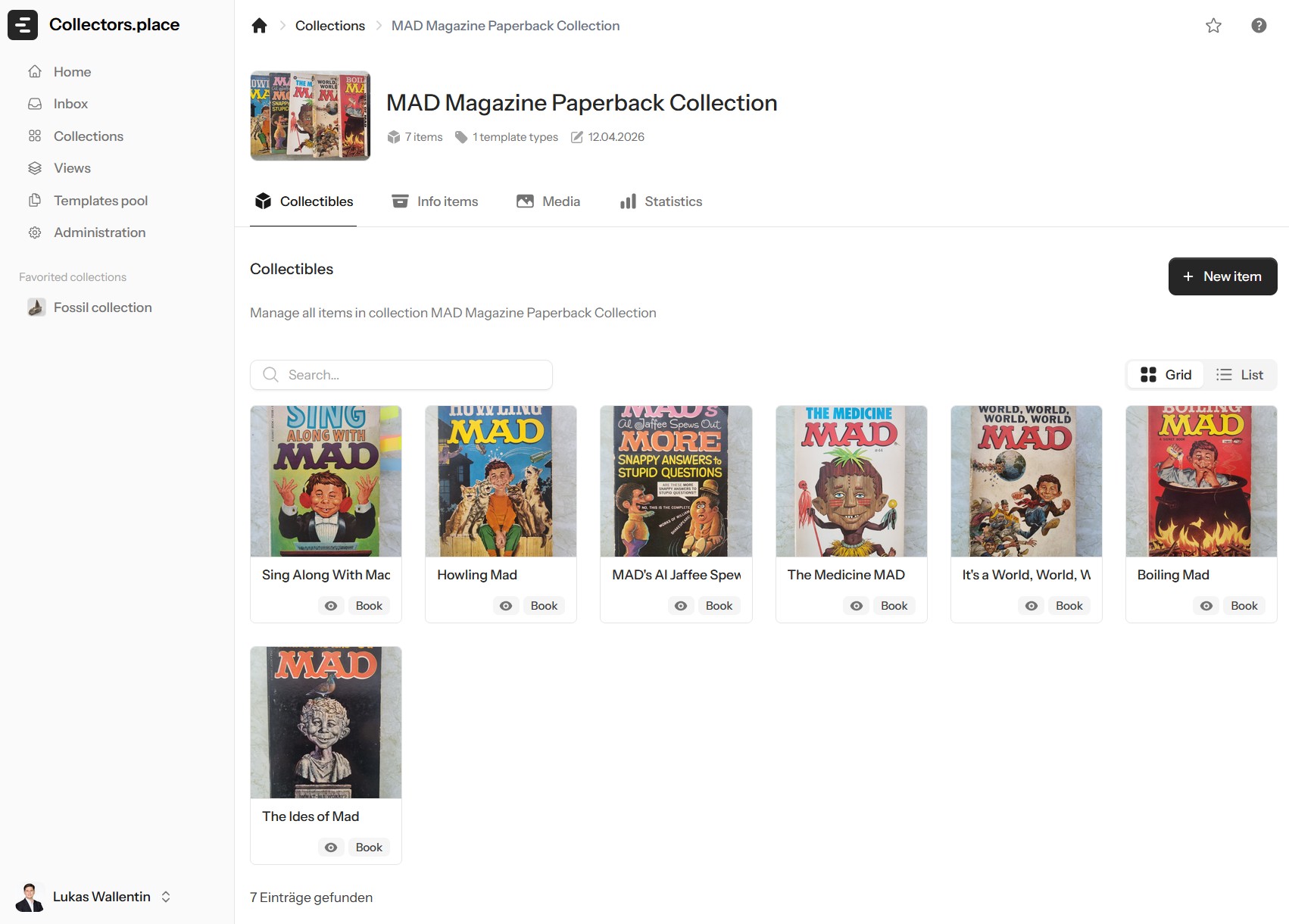
Why manage and catalogue comic book collections digitally?
Collecting comics means preserving pop culture and sequential art. But without structured documentation, crucial information is easily lost – first issues, grading details, or the origin of rare finds.
With Collectors.place, comic collectors can digitally catalogue their collection, capture essential issue and condition data, and organise their comics for the long term.
Whether a carefully curated superhero collection or an extensive manga library spanning thousands of issues: digital documentation helps preserve the value and story behind every comic.
Why comic books should be documented
A comic is more than a printed booklet. The following details are especially important for a collection's value and history:
- Title, series, and issue number
- Writer and penciller
- Publisher, release year, and edition
- Condition and professional grading
- Provenance and acquisition history
Without this data, a comic – particularly a rare first issue or key issue – loses a significant part of its collector and monetary value.
A digital comic book database ensures that this information is preserved permanently.
Capturing complete issue data
The foundation of every entry is the precise recording of key bibliographic information.
Typical fields include:
- Title and description
- Series and issue number
- Writer and author
- Penciller and artist
- Publisher
- Release year and publication date
- ISBN and language
This allows every comic to be clearly identified within the collection and cross-referenced with external databases such as the Grand Comics Database (GCD) or ComicBookDB.
Documenting condition and grading
The condition of a comic is critical to its value – especially for older or rarer issues. With Collectors.place, the condition can be recorded precisely and a professional grade documented, for example according to CGC or PGX standards.
This keeps the current condition of every issue traceable and comparable at any time – even years down the line.
Recording edition and special features
Many comics exist in multiple variants that can differ significantly in value.
Key details include:
- Edition (first printing, reprint, variant cover, signed edition …)
- Special features (printing error, inserts, signature, stamp …)
These details make the difference between an ordinary copy and a valuable rarity – and should be documented without gaps.
Documenting origin and historical context
The origin of a comic can be equally fascinating for collectors and cultural historians alike.
Fields available for documentation include:
- Place of origin and region or country
- Period of creation
- Context of creation (e.g. historical significance, social context, influence on the genre)
This allows the cultural and historical context of an issue to be preserved for the long term.
Provenance and collection history
The acquisition history of a comic is especially important for valuable copies.
Fields available for documentation include:
- Date added to the collection
- Method of acquisition (purchase, gift, estate, trade …)
- Acquired from (dealer, private seller, auction …)
- Purchase price and insurance value
- Previous owners
This allows the history of a comic to be traced without gaps – across decades if necessary.
Organising comics within the collection
Beyond content details, a digital database also supports practical collection management.
For example through:
- Individual inventory numbers
- Current storage location (shelf, box, archive folder …)
- Position and slot within the storage setup
- Storage notes (e.g. acid-free bags and boards, UV-protected storage, temperature recommendations)
- Insurance value
For larger collections in particular, this provides a significant overview – and proves invaluable in the event of insurance claims or inheritance.
Capturing the context and significance of a comic
Many issues carry a special history or meaning within a collection.
Additional information can therefore also be documented:
- History of the object (e.g. dedication, origin from an estate, personal memory)
- Significance for the collection
- Relation to the collecting focus (e.g. Golden Age, Silver Age, European bande dessinée, manga …)
This information makes a collection more valuable over time and easier to understand – for heirs, buyers, or future generations.
Long-term documentation of a comic book collection
Digital documentation helps comic collectors to:
- catalogue their collection clearly and efficiently
- store issue, edition, and grading data
- preserve origin and historical context permanently
- document provenance and acquisition history completely
- keep track of storage locations and insurance values
A structured comic book database ensures that important information is never lost – even across very large collections.