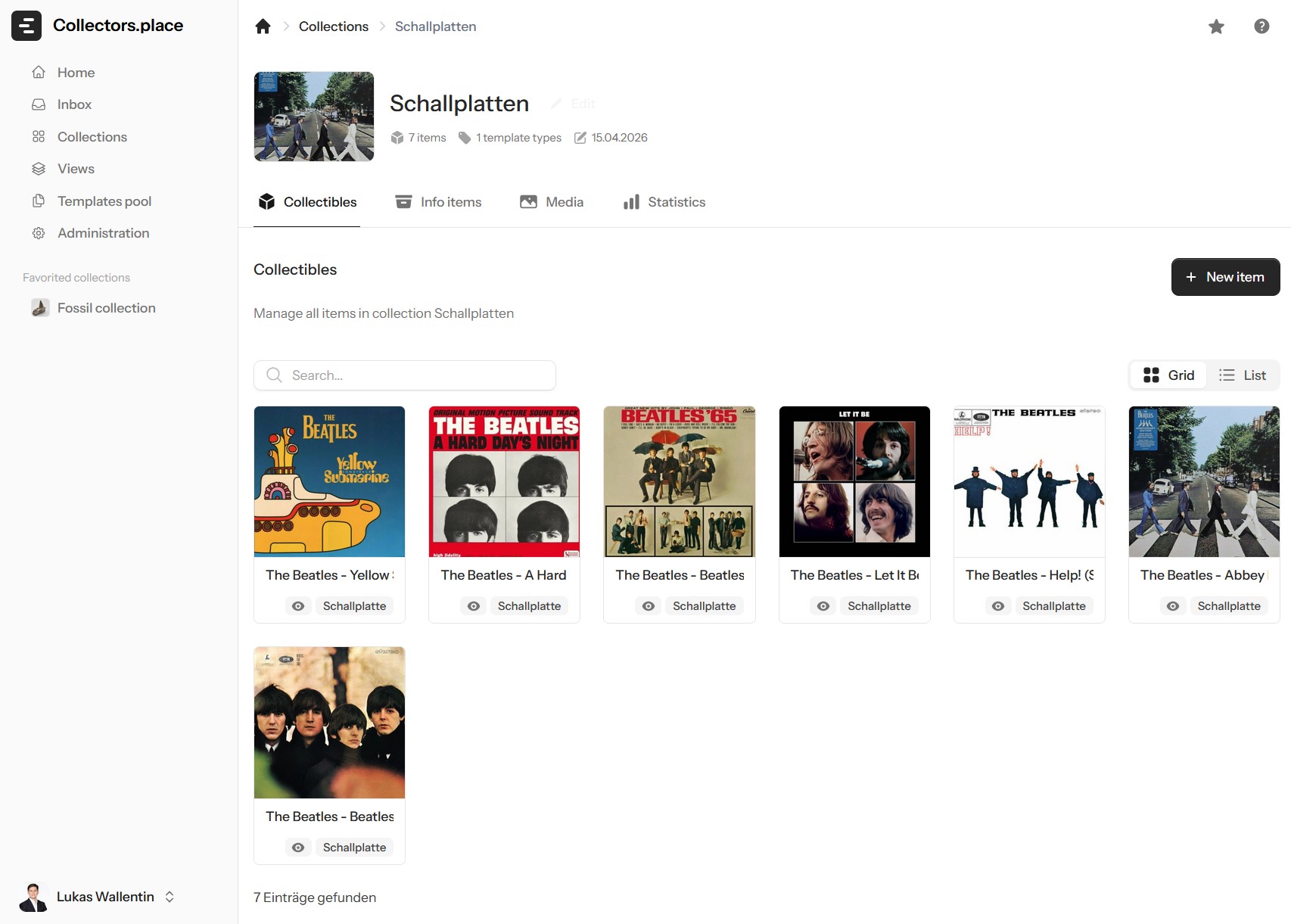
Why manage and catalogue vinyl record collections digitally?
Collecting records means preserving music history. But without structured documentation, crucial information is easily lost – first pressings, catalogue numbers, or the origin of rare finds.
With Collectors.place, record collectors can digitally catalogue their vinyl, capture essential pressing details, and organise their collection for the long term.
Whether a carefully curated jazz collection or an extensive rock library spanning thousands of titles: digital documentation helps preserve the value and story behind every record.
Why vinyl records should be documented
A record is more than just a sound carrier. The following details are especially important for a collection's value and history:
- Artist, label, and release year
- Country of pressing and edition
- Condition of both record and sleeve
- Catalogue number and matrix number
- Provenance and acquisition history
Without this data, a record – particularly a first pressing or rare variant – loses a significant part of its collector and monetary value.
A digital vinyl database ensures that this information is preserved permanently.
Capturing complete album data
The foundation of every entry is the precise recording of key album information.
Typical fields include:
- Album title and description
- Artist or band
- Label and record company
- Year of release
- Catalogue number
- Track listing
This allows every record to be clearly identified within the collection and cross-referenced with external sources.
Documenting format and technical specifications
For collectors, the technical specifications of a record are of great importance.
Key details include:
- Format (7", 10", 12", LP, EP, Single, Maxi-Single, Picture Disc …)
- Playback speed (33⅓, 45, or 78 RPM)
- Pressing and edition (original pressing, reissue, limited edition …)
- Matrix number
These details reveal which specific release a copy represents – and are often decisive for valuation.
Recording the condition of record and sleeve
The condition of a record is critical to its value. With Collectors.place, the condition of the record and sleeve can be documented separately – using established grading standards such as the Goldmine grading system.
This keeps the current condition of every copy traceable and comparable at any time.
Documenting origin and historical context
The origin of a record can be equally fascinating for collectors and music historians alike.
Fields available for documentation include:
- Place of origin and region or country
- Period of creation
- Context of creation (e.g. historical significance, recording circumstances, band history)
This allows the cultural and historical context of a release to be preserved for the long term.
Provenance and collection history
The acquisition history of a record is especially important for valuable rarities.
Fields available for documentation include:
- Date added to the collection
- Method of acquisition (purchase, gift, estate …)
- Acquired from (dealer, private seller, auction …)
- Purchase price and insurance value
- Previous owners
This allows the history of a record to be traced without gaps – across decades if necessary.
Organising records within the collection
Beyond content details, a digital database also supports practical collection management.
For example through:
- Individual inventory numbers
- Current storage location (shelf, room, storage unit …)
- Position and slot within the storage setup
- Storage notes (e.g. stored upright, away from light, temperature recommendations)
- Insurance value
For larger collections in particular, this provides a significant overview – and proves invaluable in the event of insurance claims or inheritance.
Capturing the context and significance of a record
Many records carry a special history or meaning within a collection.
Additional information can therefore also be documented:
- History of the object (e.g. signed copy, live recording, personal memory)
- Significance for the collection
- Relation to the collecting focus (e.g. Blue Note jazz, Krautrock, post-punk …)
This information makes a collection more valuable over time and easier to understand – for heirs, buyers, or future generations.
Long-term documentation of a vinyl record collection
Digital documentation helps record collectors to:
- catalogue their collection clearly and efficiently
- store pressing details and technical specifications
- preserve origin and historical context permanently
- document provenance and acquisition history completely
- keep track of storage locations and insurance values
A structured vinyl database ensures that important information is never lost – even across very large collections.