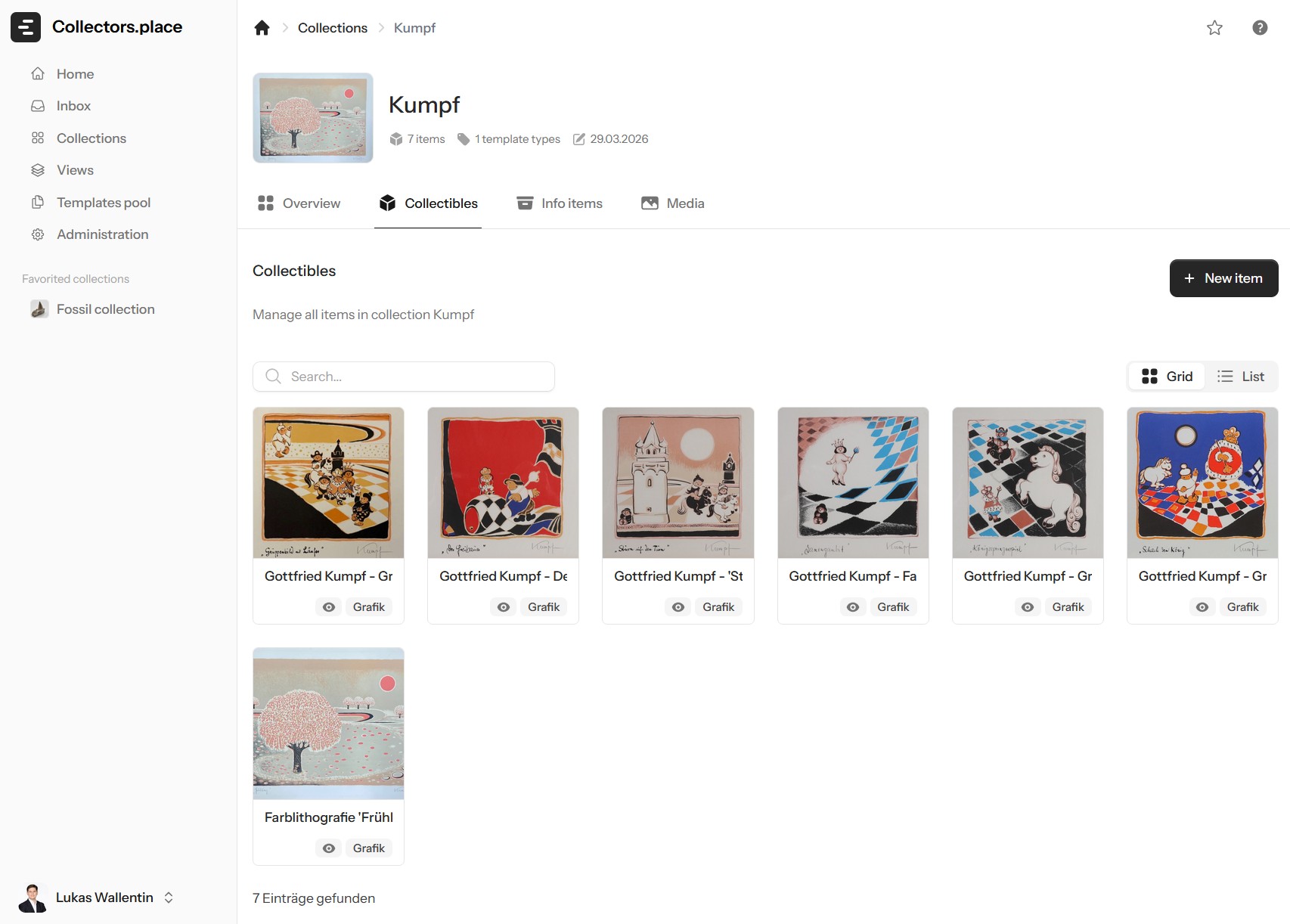
The software for collectors who take precision seriously
Generic inventory apps don't know the difference between an etching and an aquatint. collectors.place does.
Our prints & graphics template was developed together with passionate collectors and art historians, covering everything — from printing technique to insurance value, from year of creation to airtight provenance. Manage your graphic art collection online, structured and securely preserved for the long term.
Every object has a history. We make it visible.
What you can document with collectors.place
The prints & graphics template covers the full spectrum — from art-historical classification and technical details to complete provenance and collection management.
Core data & printing technique
Everything needed to uniquely identify a work — title, description, artist name with reference, year of creation, and the printing technique used.
- Title and detailed description
- Artist name and artist reference (linked to the artist profile in your collection)
- Year of creation (1400–2100)
- Printing technique — etching, lithograph, woodcut, screen print, aquatint, and more
Physical dimensions & format
Metrically precise, with validated value ranges — distinguishing between sheet dimensions and image dimensions, as required in professional documentation.
- Sheet height and sheet width in cm
- Image height and image width in cm
Print-specific details
All the specialist information that determines the value and uniqueness of a printed work — edition, signature, printing house and paper type.
- Edition (e.g. 3/50, 1st state, artist's proof)
- Signature
- Printing house / workshop
- Paper type (e.g. laid paper, Japan paper, vellum)
- Condition (selection from a defined scale)
Art-historical classification & origin
Where does the work come from — and what art-historical context does it belong to?
- Art-historical classification as detailed free text
- Place of origin and region / country
- Period of creation (e.g. Early Baroque, Weimar Republic)
- Context of creation as detailed free text
Provenance
The unbroken history of the work in human hands — indispensable for the art market, valuation, and the ethical responsibilities of collecting.
- In the collection since (date)
- Type of acquisition — purchase, exchange, gift, bequest
- Acquired from
- Price paid
- Previous owners as detailed free text
Storage & inventory
A digital inventory with all administrative information at a glance.
- Inventory number
- Current location and position / shelf
- Insurance value
- Storage notes — light sensitivity, humidity, temperature, acid-free housing
Context & significance
What makes this work special to your collection? This is where the narrative richness develops that turns a holdings list into a story.
- History of the object
- Significance for the collection
- Relation to the collection's focus
The complete prints & graphics template at a glance
All 35+ fields of the template, organised by category:
Core data & technique — Title, Description, Artist name, Artist reference, Year of creation, Printing technique, Edition, Signature
Dimensions & materials — Sheet height, Sheet width, Image height, Image width, Printing house / workshop, Paper type
Art-historical classification & origin — Condition, Art-historical classification, Place of origin, Region / country, Period of creation, Context of creation
Provenance — In the collection since, Type of acquisition, Acquired from, Price, Previous owners
Storage & administration — Inventory number, Current location, Position / shelf, Insurance value, Storage notes
Context & significance — History of the object, Significance for the collection, Relation to the collection's focus
Cataloguing your print collection digitally — in 4 steps
- Create your collection — Choose the prints & graphics template and get started immediately. No setup, no configuration, no learning curve.
- Record your works — With photographs, dimensions, printing technique and complete art-historical and provenance context.
- Search your collection — Filter by technique, year of creation, condition, artist or any other field — instantly.
- Share & preserve — Present your collection, generate digital catalogues, and secure the documentation for future generations.
The best way to document a graphic art collection
Whether you have 12 showcase pieces in a cabinet or are building a systematic collection of several hundred prints and works on paper — collectors.place grows with you. As a prints database, inventory system and collection catalogue in one.
No field too many. No field too few.
Start for free and record your first work today. The prints & graphics template is ready to use immediately — no setup, no specialist knowledge required.
Register for free | Learn more about collectors.place
Frequently asked questions about managing a print collection digitally
Which printing techniques can I catalogue?
The template is open to all printing techniques — relief processes such as woodcut and linocut, intaglio processes such as etching, aquatint, engraving and mezzotint, planographic processes such as lithography and offset, as well as screen printing and digital print. The "printing technique" field is free text and therefore completely flexible.
Can I create artist profiles and link them to individual works?
Yes. The "artist reference" field lets you link every work directly to an artist profile within your collection. This automatically generates an overview of all works by a given artist.
How do I document provenance correctly?
collectors.place offers five dedicated fields for this: date of acquisition, type of acquisition, previous owners, purchase price, and a detailed free-text field for the full ownership history. For works with complex provenance — for example from the period of National Socialism — we recommend making full use of the free-text field and linking any supporting source documents.
Is collectors.place suitable for mixed collections?
Yes. In addition to the prints & graphics template, collectors.place offers templates for other collecting areas. Within a single collection account, you can use multiple templates side by side.
How secure is my data?
Your collection is password-protected and stored on secure European servers. You decide which parts of your collection are publicly visible and which remain private.
What is the difference between sheet dimensions and image dimensions?
Sheet dimensions refer to the full size of the physical paper or support. Image dimensions refer to the area of the actual printed image or plate mark. Both measurements are standard in professional print cataloguing and are recorded separately in the template.