Why Manage a Model Collection Digitally?
Collecting models means preserving technical and cultural history in miniaturised form. Model cars, railway locomotives, aircraft models, and ship models document the state of design and engineering of their respective eras – and as collector's items, many are today of considerable value. But without a structured, digital approach, critical information is easily lost: scale and prototype, precise manufacturer data, first editions and limited runs, the condition at the time of purchase, or the origin of a rare variant.
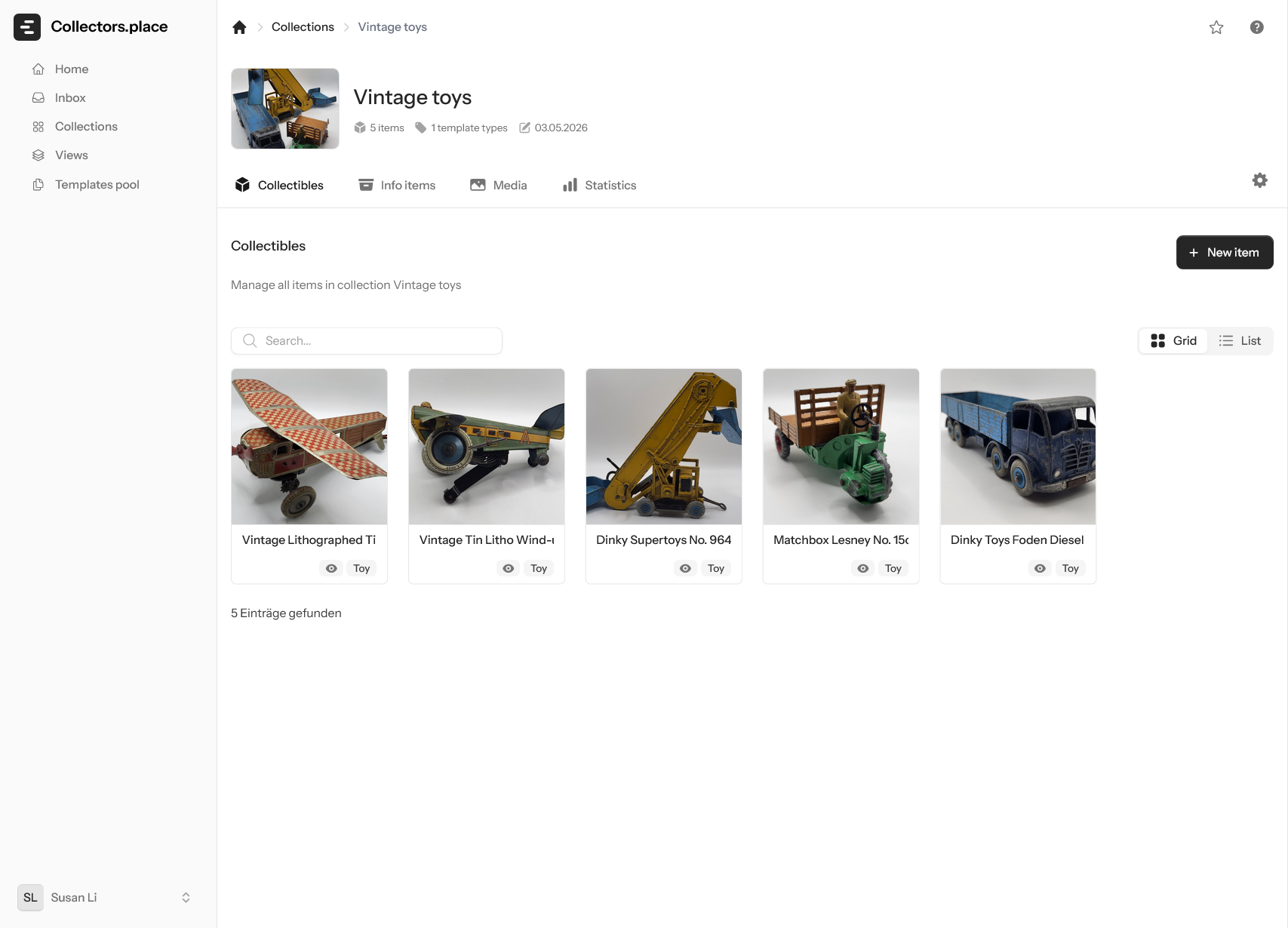
With Collectors.place, model collectors can digitally capture and catalogue their entire inventory, record all essential details in a structured way, and organise their collection securely for the long term – from a single Dinky Toys model from the 1950s to an extensive Märklin layout filling an entire room.
Every model is a miniaturised piece of industrial history. The purpose of a collection is to make sure that knowledge is never lost.
Why Model Collections Should Be Properly Documented
A model is more than a miniature – it is a testament to craftsmanship, licensing history, and collector culture. For long-term collection value and accurate classification, the following details are especially important:
- Model type, manufacturer, and year of production
- Scale and prototype (the real vehicle, the real locomotive, the real aircraft)
- Item number, edition, and production run
- Condition and completeness of original packaging
- Material, detail features, and fittings
- Provenance, acquisition history, and previous owners
Without this data, a piece – particularly a limited edition, a first-release model, or a rare colour variant – loses a significant part of its collector and market value. A digital model database ensures that this information is preserved permanently, completely, and remains searchable at any time.
Cataloguing a Model Collection: What Data Really Matters
Core Data & Identification
The foundation of every entry in a digital model collection is the precise recording of key object data:
- Name – the unique designation of the model, e.g. Mercedes-Benz 300 SL Gullwing, red, 1955
- Description – detailed free text providing a full description of the piece
- Model Type – e.g. die-cast model, kit, ready-to-run, steam locomotive, commercial airliner
- Manufacturer and Manufacturer Reference – with a direct link to the manufacturer entry within the collection
- Scale – e.g. 1:18, 1:43, 1:87 (HO), 1:160 (N), 1:72
- Item Number – the manufacturer's order number for unambiguous identification
- Model Year – the year the model was released (not the prototype), documentable from 1900 to 2100
Prototype & Material
A central characteristic of every model is its connection to the real-world subject it represents:
- Prototype – the original being depicted, e.g. Porsche 356 A Coupé, 1957 or DB Class 01 steam locomotive
- Material – e.g. die-cast (zinc alloy), white metal, plastic (ABS), brass, resin
Condition, Edition & Special Features
- Condition – graded according to a defined collecting standard (e.g. mint in box, excellent, good, played with)
- Packaging present – e.g. original box, polystyrene insert complete, certificate of authenticity included
- Edition / Production Run – e.g. limited edition of 500 pieces, special edition, first release, dealer exclusive
- Details / Features – free text for special detail features, level of detail, opening parts, functions, engravings, printed components
Documenting the Origin and Historical Context of a Model Collection
The geographic and temporal origin of a model is often just as significant for collectors and model historians as its condition. Particularly for early Dinky Toys, East German ESPEWE models, or Japanese tin toy vehicles, the context of production provides crucial clues about rarity, licensing history, and historical importance.
Origin
- Place of Origin – e.g. Göppingen (Märklin), Nuremberg (Schuco), Liverpool (Dinky Toys), Tokyo
- Region / Country – e.g. Baden-Württemberg, Germany, Saxony, East Germany, England, Japan
- Period of Creation – e.g. post-war era, economic miracle years, 1960s, early West Germany
- Context of Creation – free text for historical classification, licensing history, production circumstances, and cultural significance
For early post-war models from Germany or Japan, place of manufacture and production context are often decisive for classification and value – far more so than condition alone.
Recording Provenance and Acquisition History in Full
A complete acquisition history is especially important for valuable first editions, inherited pieces, or objects from notable collections – both for their market value and for their historical classification.
Provenance
- In the collection since – precise date of acquisition
- Method of acquisition – e.g. purchase, gift, inheritance, auction, trade, fair
- Acquired from – dealer, private seller, auction house, swap meet, or fair
- Price – documented purchase price in euros
- Previous owners – free text for a complete, traceable chain of ownership
A fully documented provenance not only increases the value of the record – for rare or highly limited models, it can also substantially raise the achievable sale price.
Organising a Model Collection: Storage and Inventory Management
Beyond content documentation, Collectors.place also supports the practical management and organisation of a model collection – whether it is stored in a display cabinet, a showcase, a depot, or spread across multiple locations.
Storage & Management
- Inventory number – e.g.
MOD-1955-0087for unambiguous internal identification - Current location – room, display cabinet, shelf, or external storage
- Position / compartment – precise placement within the location for quick retrieval
- Insurance value – current estimated value in euros for insurance and estate purposes
- Storage notes – e.g. use UV-protective glass, dust cover recommended, max. 50% relative humidity, avoid direct sunlight
For larger collections in particular, this structure provides a significant overview – and proves invaluable in the event of damage, relocation, or inheritance.
Tip: Assign inventory numbers systematically – for example, by model type, scale, and sequential number. Record the current location consistently so that every piece in a large collection can be found immediately.
Recording the Significance and Context of a Collector's Item
Many models are significant not only because of their condition or rarity – they carry a personal, historical, or collection-specific meaning that exists nowhere else but within the collection itself.
Context
- History of the object – e.g. first edition with original packaging from dealer stock, part of a deaccessioned exhibition collection, personal gift to mark a milestone
- Significance for the collection – why does this piece belong in the collection, and what makes it special?
- Relation to the collecting focus – e.g. centrepiece of the 1950s Schuco collection, only known red variant of this production run, key piece of the Märklin steam locomotive series
This information makes a model collection more valuable and easier to understand over time – for heirs, prospective buyers, curators, or future generations.
Managing a Model Collection Digitally – A Summary
Digital collection management with Collectors.place helps model collectors to:
- catalogue their collection completely and systematically – from individual pieces to the entire holdings
- preserve manufacturer details, scale, prototype, and technical data permanently and without loss
- record edition, production run, and item number precisely and searchably
- document geographic origin and historical context traceably and in full
- capture provenance and acquisition history without gaps – and in a way that adds value
- manage storage locations, insurance values, and care instructions accessible at any time
- preserve the story and significance of every piece for the future
A well-structured digital model database ensures that important information is never lost – regardless of the size of the collection, its geographic distribution, or the passage of generations.