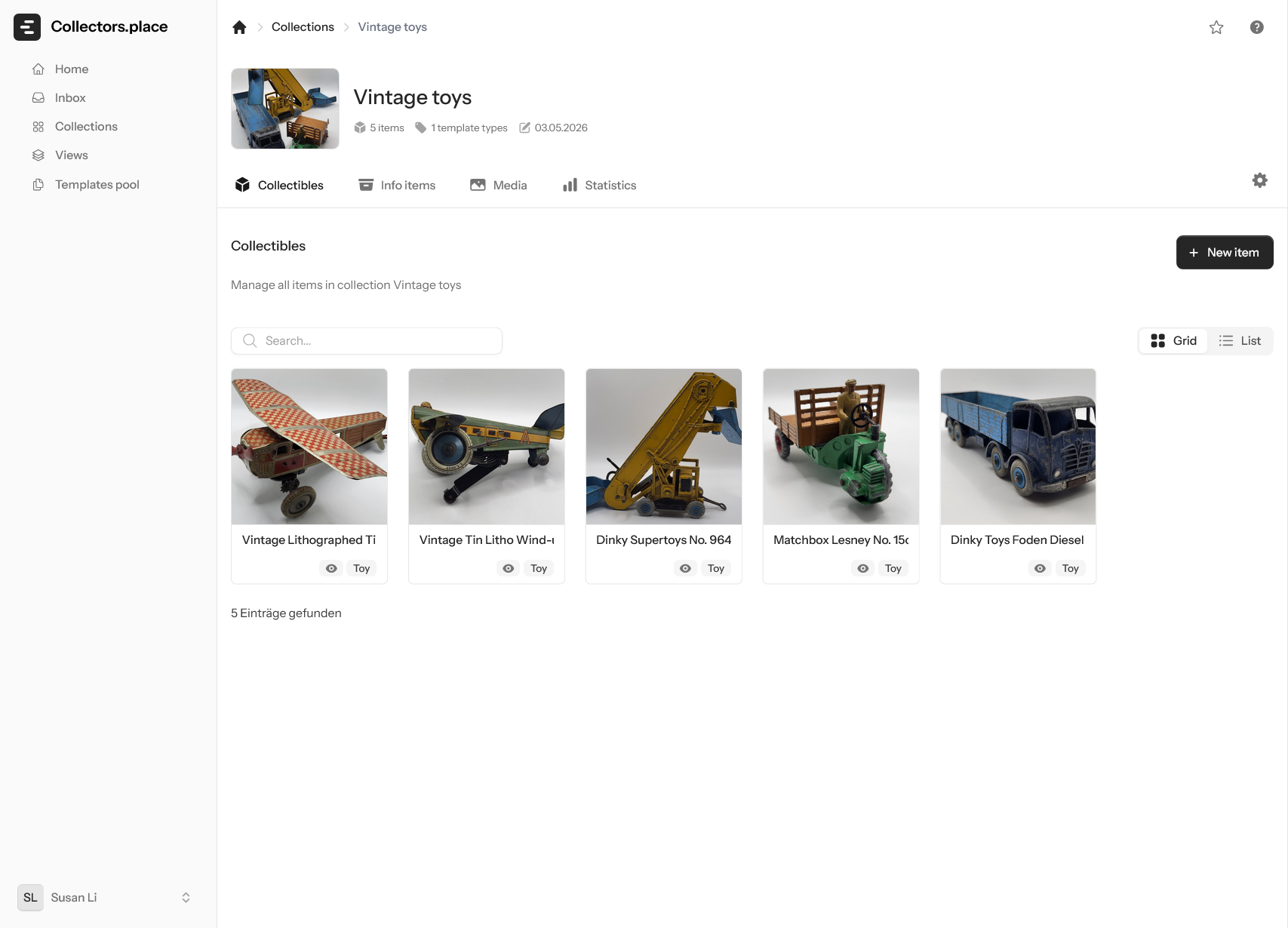
Why manage toy collections digitally?
Collecting toys means preserving cultural history. But without structured digital management, essential information gets lost: first editions, exact manufacturer data, condition at the time of acquisition, or the origin of rare finds. Anyone who wants to manage their toy collection digitally needs a tool that goes far beyond a simple list.
With Collectors.place, toy collectors can digitally record and catalog their entire inventory, store all essential details in a structured way, and organize their collection securely for the long term – from a single vintage tin car to a large LEGO collection.
Every toy carries a story. The purpose of a collection is not to lose that story.
Why toys should be carefully documented
A toy is more than an object – it is a piece of cultural, industrial, and childhood history. For long-term collectible value and proper classification, the following information is especially important:
- Manufacturer, series, and year of production
- Item number and manufacturer reference
- Condition and completeness of original packaging
- Material, dimensions, and toy type
- Provenance, acquisition history, and previous owners
Without this data, a piece – especially a first edition, prototype, or limited variant – loses a significant part of its collectible and market value. A digital toy database ensures that this information is permanently, completely, and reliably preserved.
Recording a toy collection: which data really matters
Basic data & identification
The foundation of every entry in a digital toy collection is the precise recording of essential object data:
- Name – the unique designation of the object
- Description – detailed free-text description of the item
- Manufacturer and manufacturer reference – with direct linking to the manufacturer entry in the collection
- Series / product line – e.g. Masters of the Universe, LEGO Technic, Märklin H0, Playmobil 3666
- Year of manufacture – recordable from 1800 to 2100
- Item number and toy type (e.g. vehicle, doll, board game, model railway)
Material & dimensions
For a complete physical description – for example for insurance purposes or comparison with catalog data – the following fields are supported:
- Material (selection: e.g. tin, plastic, wood, fabric, cast iron, ceramic)
- Length, width, and height in centimeters
Condition & special features
Condition is a key quality attribute for every collectible. Collectors.place records:
- Condition – according to a defined collecting standard (e.g. mint, very good, good, played with)
- Packaging present – e.g. original box, complete inlay, manual included
- Functionality – e.g. fully functional, mechanically limited, display only
- Rarity – free text for market assessment and availability
- Special features – free text for signatures, known variants, misprints, or unusual characteristics
Documenting the origin and historical context of a toy collection
The geographical and historical origin of a toy is often just as important to collectors and cultural historians as its condition. Especially for antique toys, East German toys, or Japanese tin toys, the production context provides crucial clues about rarity and significance.
Origin
- Place of origin – e.g. Giengen an der Brenz, Nuremberg, Tokyo
- Region / country – e.g. Bavaria, Germany, Saxony, GDR, Occupied Japan
- Time of origin – e.g. pre-war period, post-war period, 1950s, early West Germany
- Context of creation – free text for historical classification, production conditions, zeitgeist, and cultural significance
Especially for toys from the early 20th century, country of origin and production context are often more important than the brand name itself.
Recording provenance and acquisition history without gaps
A complete acquisition history is especially important for valuable rarities, inherited items, or objects from significant collections – both for market value and historical classification.
Provenance
- In collection since – exact acquisition date
- Type of acquisition – e.g. purchase, gift, inheritance, auction, exchange
- Acquired from – dealer, private person, auction house, or fair
- Price – documented purchase price in euros
- Previous owners – free text for a complete, traceable ownership chain
Organizing a toy collection: storage and inventory
In addition to content documentation, Collectors.place also supports the practical management and organization of a toy collection – whether stored in a display cabinet, archive, or across multiple locations.
Storage & management
- Inventory number – e.g.
TY-1952-0041 - Current location – room, display case, shelf, or storage unit
- Position / compartment – precise placement within the location
- Insurance value – estimated value in euros
- Storage notes – e.g. temperature, light protection, handling instructions
Tip: Use a consistent numbering system (toy type + decade + running number).
Recording meaning and context
Context
- Object history – e.g. signed piece, museum collection item, childhood toy
- Significance for the collection
- Relation to collection focus – e.g. DDR toys, early plastics industry, first editions
Overview
Digital collection management with Collectors.place helps you:
- catalog your entire toy collection systematically
- preserve technical and historical data long-term
- document origin and provenance
- organize storage and locations
- retain the story and value of each piece